

Acetate glasses: what cellulose acetate is, how it's made and how to spot it
Before it was a pair of glasses, it was cotton and wood. What cellulose acetate is, how a sheet becomes a frame, and how to tell it from moulded plastic.
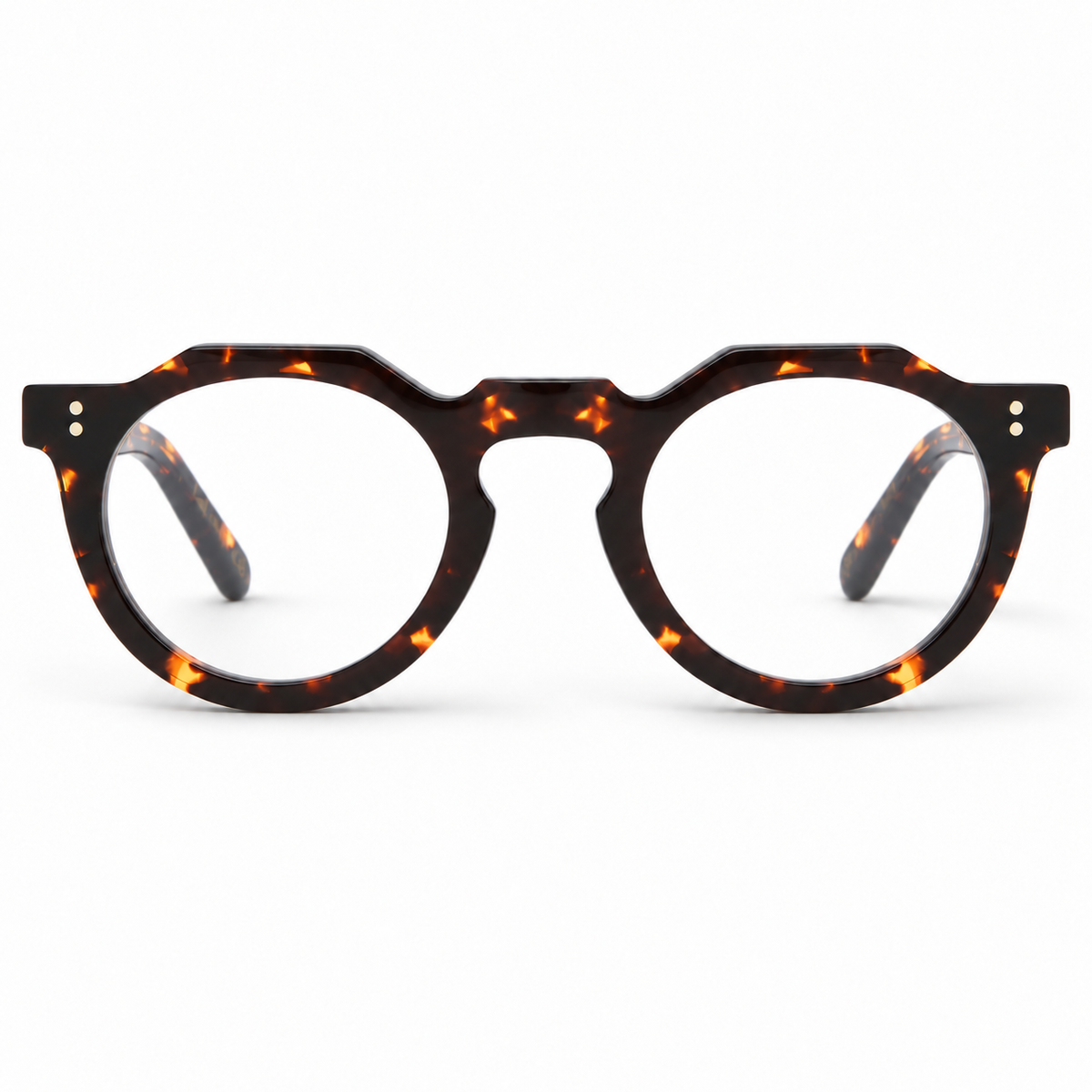
Before it was a pair of glasses, it was cotton and wood.
Most of the coloured frames you'll find in our boutique are cellulose acetate. The name sounds technical, but it describes a material born from plant fibres, shaped by taking material away and recognisable at your fingertips. Here is how it's made, how to tell it from moulded plastic and how to make it last.

What acetate is
Cellulose acetate is a polymer made from cellulose, the fibre found in plants, sourced mainly from cotton and wood. The cellulose is treated with acetic acid, then made workable with a plasticiser. The result is a material that feels warm to the touch, takes deep colour and can be shaped with heat.
In Italy, acetate has a very specific story. Mazzucchelli, founded in 1849 in Castiglione Olona, in the province of Varese, originally worked natural tortoiseshell and is today one of the world's leading producers of acetate sheet for eyewear. Its M49 is a phthalate-free formulation, made from renewable sources and biodegradable.
How it becomes a pair of glasses
The sheet
The colour isn't painted on: it lives inside the material. Layers and fragments of coloured acetate are joined and pressed, then cut into sheets. That's how a havana pattern or a two-tone transparency comes to be.
Milling
The front and temples are cut from the sheet by removing material, with cutters that follow the design of the frame. The thickness of the sheet decides how much volume the finished frame can have.
The core wire
A metal core wire is heat-set into each temple. It's the line you see running along the temple of a clear frame, and it's what lets an optician adjust the fit.
Tumbling
The pieces spend a long time turning in barrels with wood chips and abrasive pastes. The edges soften and the surface is readied for polishing.
Polishing
Cloth wheels and polishing compounds give acetate its depth. It's the stage where the maker's hand shows the most.
Acetate or moulded plastic: how to tell
Many inexpensive frames are injection-moulded: molten material is poured into a mould and the colour often sits only on the surface. A few simple checks will tell you what you're holding.
Acetate
- Colour runs deep, visible on the edge too
- Substantial weight, smooth and warm surface
- Metal core wire in the temples
- Can be heat-adjusted by an optician
- Can be re-polished
Moulded plastic
- Uniform or surface-only colour
- Very light, sometimes with mould marks
- Temples often without a core wire
- Little or no room for adjustment
- Once damaged, it can't be restored
Six acetates to look at up close

Lesca Pica 3 Crystal
Clear acetate hides nothing: the core wire in the temples, the hinge pins, the true thickness of the front.
View the frame
AHLEM Gambetta
A luminous havana, with honey-toned areas that let the light through: the pattern reads best where the thickness varies.
View the frame
Sestini Ventitrè
The same pattern at the other end of the scale: a dark, glossy havana whose grain only emerges against the light.
View the frame
Cubitts Matilda Celadon
A solid, even green on a cat-eye shape: here acetate works like a pigment, with no grain at all.
View the frame
Cubitts Panton Stone Blue
A dusty blue on a square front: proof that even a soft colour has depth in acetate.
View the frame
AHLEM Rue du Soleil
A barely veiled transparency on an oval shape: the tint shifts in intensity with the thickness the light passes through.
View the frameHow to make it last
Heat is acetate's main enemy: left on a dashboard in the sun, it can warp. Clean it with lukewarm water and a microfibre cloth, without alcohol or harsh detergents. Over the years the surface can lose its shine: a re-polish in the boutique brings it back to how it was. You'll find other good habits in How to care for your glasses.
If you're choosing between two materials, the comparison with metal is in Titanium or acetate glasses. For acetate's most classic pattern, read Tortoiseshell glasses: the havana pattern.
Is acetate plastic?
It is a plastic material, but its base is cellulose from cotton and wood. That's why it behaves differently from moulded plastics: it's milled rather than moulded, takes colour in depth and can be adjusted with heat.
Can acetate glasses be adjusted?
Yes. The optician warms the front or the temples and reshapes them; the metal core holds the new shape. It's one of the reasons an acetate frame adapts well to your face.
How much do acetate glasses weigh?
It depends on the thickness of the sheet: thin acetate is light, while a full front weighs more than a titanium frame. Comfort also depends on the bridge, the nose pads and the adjustment.
Does the sun damage acetate?
Intense heat can warp it, in a car in summer, for example. Normal daylight won't. Keep your glasses in their case when you're not wearing them.
Recognise it by touch
In our boutique in Crema (Italy) you can hold a clear acetate, a havana and a solid colour in your hands, and feel the difference from a moulded frame. Online you'll find hundreds of acetate frames, with measurements and photographs.
Sources: Mazzucchelli 1849 · Macplas, «Dalle tartarughe alle bioplastiche»