

Polarized lenses: what they are, when you need them, and 6 designer polarized sunglasses
Polarized lenses remove the glare off asphalt, water and snow. How they work, when they are worth it (driving, sea, mountains), when they get in the way (screens), how to spot a real one, and the six polarized frames in the OCCHIO! selection, plus polarized prescription lenses on any frame.
The sun is not the problem. The glare is.
A regular sunglass lens lowers the light. A polarized lens removes the light that bounces: off asphalt, water, snow, the bonnet of the car. It is the difference between seeing less and seeing better. Here is how they work, when they are really worth it, when they are not, and the six polarized frames in the OCCHIO! selection.
the angle of the filter to reflected light: that is how it blocks it
the category of almost every polarized lens: full sun, sea, mountains
polarized frames available now; polarized prescription lenses on any frame
How it works, in two lines
Light bouncing off a horizontal surface comes out almost entirely horizontally oriented. The polarizing filter is a film with vertical micro-slits: it lets normal light through and blocks the horizontal light, that is, the glare. The result is a more contrasted image, more saturated colours and no flare on water or road. The filter is laminated inside the lens, not applied on top: it does not scratch and does not wear off.
When they are really worth it
- Driving. The glare off the bonnet and wet asphalt disappears. It is the number one use: anyone who drives many daytime miles should own at least one pair of polarized sunglasses.
- Sea, lake, sailing. On water, reflected light is stronger than direct light. With a polarized lens you see beneath the surface; without, you see a mirror.
- Snow and mountains. Strong glare and light from everywhere: polarized and category 3 or 4 (4 is not approved for driving).
- Fishing, golf, road cycling. The extra contrast helps you read the bottom, the green, the tarmac.
When they are not worth it, or get in the way
LCD screens, phone included, can darken or show halos through a polarizing filter depending on the angle. Some digital dashboards and petrol pump displays are harder to read. Pilots do not use them, because their instruments are LCD. And in the city, where glare is scarce and screens are everywhere, a good-quality tinted lens without polarization does the same job with fewer drawbacks. It is not a better lens in absolute terms: it is the right lens for certain situations.
Polarized prescription lenses: on any frame
The six frames below are the ones that come polarized from the maker. But any sunglass frame in the selection, and any optical frame with a suitable shape, can take polarized prescription lenses: single vision or progressive, grey, brown or green, gradient too. Grey keeps colours neutral, brown raises contrast, green is the compromise. The guide to prescription sunglasses covers categories and colours; to choose the frame, the collections by lens colour: grey, brown, green.
The six polarized frames

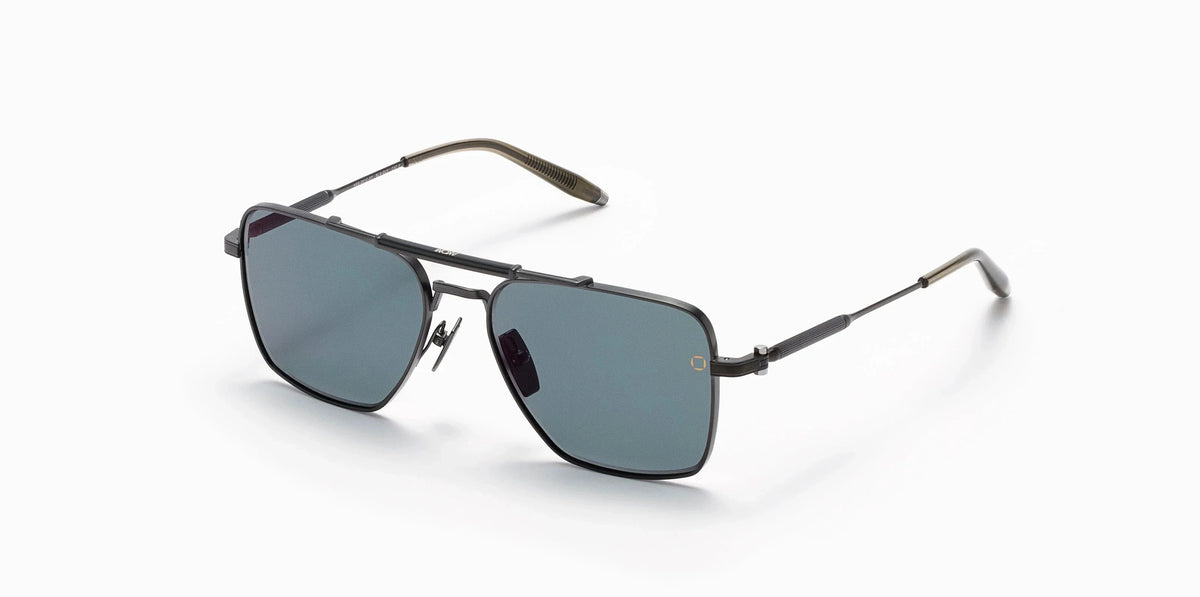
AKONI EOS Polarized Brushed Black
The only frame in the selection designed polarized from the start: brushed black Japanese titanium, 57 mm wide, polarizing filter as standard. For anyone who drives a lot.
See the product
Leisure Society Yuma 12K Silver
Los Angeles lightweight metal with a green polarized lens: green is the colour that keeps colours most true, the filter removes the glare.
See the product
Leisure Society Komenda 12K White Gold
White gold and a blue polarized lens: the rarest combination on the list. Blue polarized is made for sea and sky, where glare is strongest.
See the product
Leisure Society Bandini 12K Silver
The Bandini in 12K silver with a green polarized lens: precious metal and a driving filter, in the frame that gave the series its name.
See the product
Leisure Society Victor Black / 12K Silver
Black acetate with a precious-metal bar and a green polarized lens: Leisure Society's most structured frame, handmade in Japan.
See the product
Leisure Society Campden Black / 12K Silver
Leisure Society's most compact frame, with the silver detail and a green polarized lens: the easiest of the six to wear every day.
See the productThe thirty-second test
Do not trust the sticker. Look at your phone through the lens and rotate the glasses ninety degrees: if the screen darkens almost to black, the lens is polarized. If nothing changes, it is not, whatever the label says. In the boutique we do it in front of you with the tester, on any pair, even one you did not buy from us.
What are polarized lenses?
Sunglass lenses with an oriented filter that blocks light reflected off horizontal surfaces: water, asphalt, snow, a car bonnet. The result is less glare and more contrast. The filter does not replace UV protection, which is a separate treatment: a good polarized lens has both.
Polarized or regular sunglasses: which should I choose?
Polarized if you drive a lot, sail, spend time at the sea or in the mountains: there, glare is the main problem. Regular (or photochromic) if you wear sunglasses mostly in the city and look at screens, your phone or digital dashboards often, which can darken or show halos through a polarizing filter.
Are polarized lenses good for driving?
Yes, they are the best for daytime driving: they remove the glare off wet asphalt and the bonnet. Two exceptions: some cars' LCD dashboards are harder to read, and tinted windscreens can show coloured patches. At night no sunglass lens, polarized or not, should be worn.
Can I get polarized prescription lenses?
Yes, on any sunglass frame in the selection: single vision or progressive, in grey, brown, green and some gradient tints. Write to us with your prescription and the frame, and we will tell you lead time and price. Worldwide shipping from Italy.
How do I know if a lens is really polarized?
Look at an LCD screen (your phone, a cash machine) through the lens and rotate it 90 degrees: if the screen darkens or goes black, the filter is there. Or overlap two polarized lenses rotated 90 degrees to each other: they turn opaque.
Polarized, photochromic or mirrored?
Three different things. Polarized: removes glare. Photochromic: darkens in light and clears indoors. Mirrored: has a reflective outer layer that cuts extra light and changes the look. They can be combined: polarized and mirrored together, for example, is the lens for sailing.
Polarized lenses on the frame you want
In our boutique in Crema, Italy, we fit polarized lenses, prescription or plano, on any frame in the selection. Online, write to us on WhatsApp with your prescription and the frame: we will tell you the recommended colour, lead time and price. Worldwide shipping from Italy.