

Black eyeglasses: how to choose the frame
Glossy or matte, acetate or titanium, slim or thick profile: what changes in a black frame and how to compare models before choosing.
By OCCHIO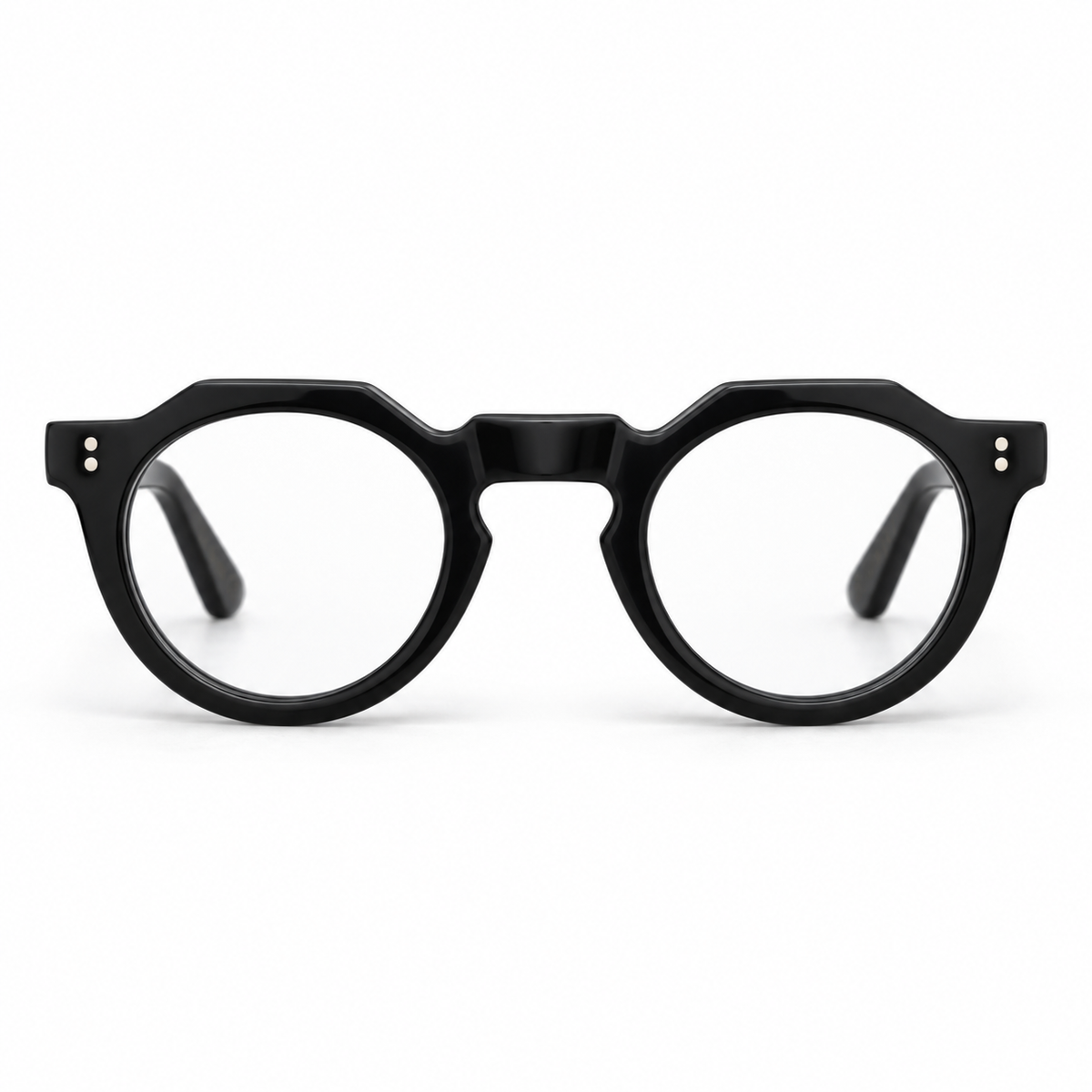
Journal · Guides
Black is the most chosen color for a prescription frame, and it's also the one where differences between models show up least in photos. Thickness, finish and material, though, change the result on the face a great deal.
Why black isn't just one color
A black frame draws a sharp line around the eyes. The thicker the front, the more that line becomes the face's main feature; with a slim profile, black stays a discreet outline. That's why two black frames of the same shape can leave very different impressions.
Finish matters too. Glossy black reflects light and shows off the curves of the front. Matte black absorbs light, softens reflections and makes the frame look more compact. Some models combine both finishes — a glossy front with matte temples, for instance.

Acetate or titanium
In acetate, the color runs through the material itself: black stays uniform even at the edges and bevels. It allows thick fronts and sculpted shapes, at a greater weight than metal.
In titanium, black is a finish applied over a light, durable metal. The profile is slim and the frame sits lightly on the nose, and its presence on the face is lighter too. Combined constructions sit in between: an acetate front or brow with a metal bridge or temples. For a fuller comparison, read Titanium or acetate glasses: what changes in the choice.

Shape and proportion
With black, a frame's shape stands out very clearly. As a starting guideline, a round or oval front softens an angular face, while a square front adds structure to softer features. It's a starting point, not a rule — the distance between the eyes, eyebrow height and personal taste all matter too.
Look at where the top edge of the frame falls. If it follows your eyebrow line, the black integrates with your features; if it sits well above or well below, it becomes a feature on its own.
Measurements to check
The temple arm carries three numbers — for example 50–20–145: lens width (the calibre), bridge width and temple length, in millimetres. The simplest way to get your bearings is to compare them with a pair of glasses you already wear comfortably. On a black frame, even a few millimetres' difference in calibre shows, because the edge is so visible. The glasses measurement guide explains how to read them.
Where to start
In the OCCHIO selection you'll find black eyeglasses from independent designers, from sculpted acetate to Japanese titanium. You can narrow the choice by shape and material and compare up to three models side by side. If you'd rather try them on, you'll also find them at the Crema boutique.