

Yellow lens glasses: what they do, when to wear them and the models
A yellow lens is the only one you wear to see more: it cuts blue light and raises contrast. What it does, when it makes sense and the eight models available now.
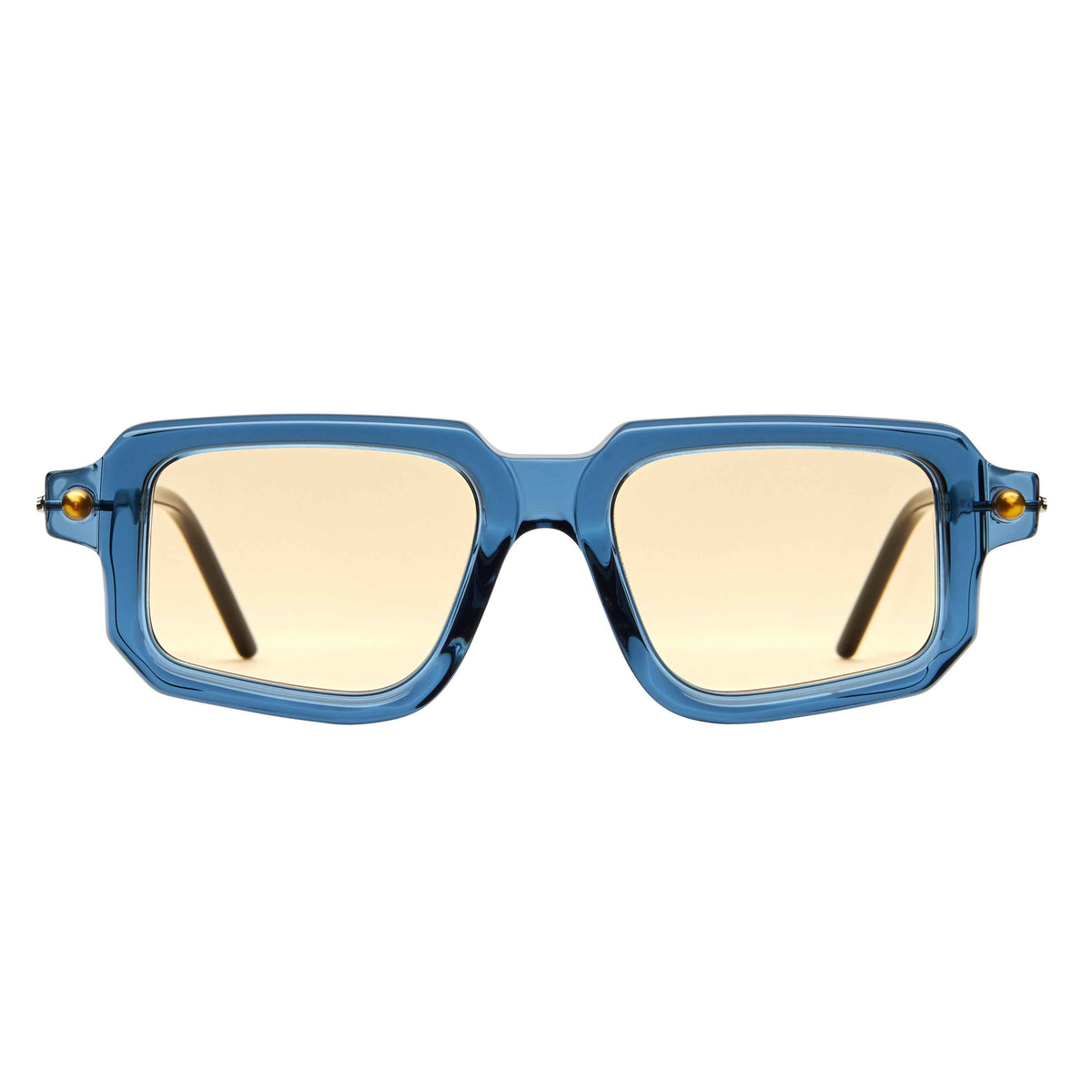
A yellow lens doesn't darken. It brightens.
It is the only colour you wear to see more, not less: it cuts blue light, raises contrast and keeps colours readable. That is why shooters have used it for a century, and why you now find it on Kuboraum's darkest fronts. Here is what it really does, when it makes sense and the eight models available now.
filter category: lets through 43% to 80% of light, against 8–18% for a dark sun lens
protection does not depend on colour: every lens on this page blocks UV
yellow lens models available now
What a yellow lens does
Blue light is the part of light that scatters most in the air: it is why the sky is blue and why, in haze or under a cloudy sky, everything looks flat. A yellow lens absorbs part of that blue and lets the rest through. The result is a sharper image, with lighter shadows and crisper edges. It is not an optical trick: it is a selective reduction of the light reaching the eye.
The trade-off is a slight shift in colour: white turns cream, blues go dull. Those who work with it, photographers, shooters, pilots, accept it gladly. Those who wear it every day notice it for the first ten minutes, then no more.
When it makes sense (and when it doesn't)
- Overcast sky, light fog, flat light. This is its territory: it brightens and gives depth to what a grey lens would flatten.
- Sunset and low sun. It warms light that is already warm and keeps contrast when a dark lens would be too much.
- Target sports. Shooting, golf, tennis, cycling in the woods: anything where you need to read an object against a background.
- Full sun. No: category 1 is not enough. You need a green lens or a grey category 3.
- Night driving. No, whatever some adverts say: no tinted lens improves vision in the dark.
How to wear it
A yellow lens gets noticed, so the frame should be chosen accordingly. Two routes. The first is contrast: black acetate or dark tortoise with a solid yellow lens, as Kuboraum does with the P23. The second is tone on tone: a champagne, honey or crystal frame with a lens in the same register, as Sauvage and Paloceras do. The first is for evenings and the city; the second also works at the office.
A practical rule: with a yellow lens, the fewer details on the frame the better. The colour is already what people see.
The eight models available now

Lesca Lunetier Picas k5
Lesca's panto with the archive yellow lens: the colour photographers used in the sixties to lift shadows. Handmade in France.
See the model
Sauvage Samourai Champagne / Mustard Yellow
Champagne frame, mustard yellow lens: the warmest pairing in the selection, on a square front made in Sabae.
See the model
Paloceras Pebble RX Crystal Honey
Transparent honey acetate and a lens in the same tone: from afar a monochrome pair, up close you can read the two layers.
See the model
Kuboraum P30 TO
The P30 Mask in tortoise with a yellow lens: the contrast between dark acetate and light lens makes it the most wearable version of this model.
See the model
Kuboraum P23 BBY
Black front, solid yellow lens: the pairing Kuboraum has used in its campaigns for years. It does not go unnoticed.
See the model
Sauvage Varda Champagne / Mustard Yellow
Sauvage's round frame in the same champagne and mustard combination: smaller than the Samourai and easier to wear every day.
See the model
T HENRI Scud Anomoly
Gradient yellow lens on a gold titanium front: the Scud is inspired by the Maserati Tipo 61 and made in 199 pieces per colour.
See the model
Balmain Brigade II
Balmain's military aviator with a light yellow lens: the most technical piece in the selection, with a metal front and double bridge.
See the modelOther tinted lenses
If you like the idea but not the yellow: orange lenses do the same job with a slightly stronger filter; green lenses alter colours the least; blue and red are a style choice before a functional one. All tinted lenses can also be made to prescription.
What are yellow lens glasses for?
A yellow lens absorbs part of the blue light and raises contrast: shadows get lighter and outlines easier to read. That is why it is used under overcast skies, in light fog, at sunset and in sport (shooting, cycling, skiing in flat light). It barely darkens: most yellow lenses are category 0 or 1.
Are yellow lenses good for night driving?
No. Available studies show no real benefit for night driving, and any tinted lens reduces the light reaching the eye. Wear them by day in low light; at night, clear lenses with anti-reflective coating.
Yellow or orange lenses: what is the difference?
They are close. Yellow brightens more and is almost clear (category 0–1); orange warms the light and filters a little more (category 1–2). If you want real sunglasses, look at orange lenses; if you want contrast without darkening, yellow.
Can they be made to prescription?
Yes. A yellow lens can be made to your prescription in our lab. Send us your prescription and the model you have chosen and we will tell you timing and price.
Do they protect from UV rays?
Yes, if the lens meets the standard: all the lenses on the models on this page are 100% UV protective, whatever their colour. UV protection does not depend on how dark a lens is.
Want to try them on?
The yellow lens glasses are in our boutique in Crema, Italy, and online with worldwide shipping.