

Square glasses: who they suit and how to choose them
Prescription or sunglasses, thin or thick: what sets a square frame apart, which faces it works on as a starting point, and which measurements to check.
Journal · Shapes
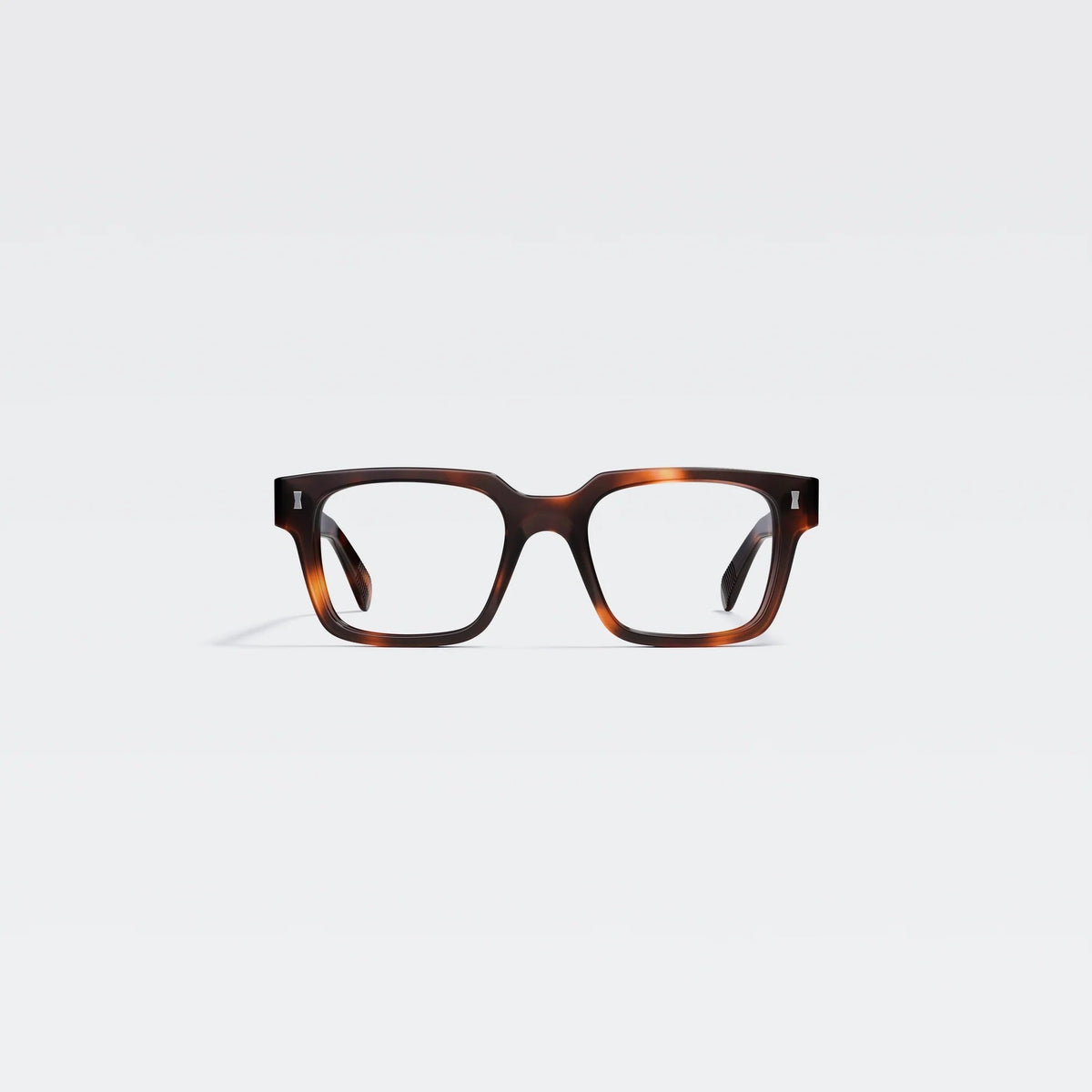
A square frame has lenses of similar height and width, with clearly visible corners. It differs from the rectangular frame, which is wider than it is tall, and from the geometric one, which multiplies the sides.
Which faces they suit
The most common advice is contrast: the frame's corners balance a round or oval face with soft contours. On a face that is already square, with a strong jaw, a very thick square tends to repeat the same lines; in that case softened corners or a slimmer profile help.
These are starting points, not rules. The distance between the eyes, the height of the eyebrows and how much you want the frame to stand out all matter too.
Slim or thick
Thickness decides how much the square dominates the face. A thick acetate front makes the shape the protagonist; a metal profile reduces it to an outline. The curve of the corners changes a lot as well: sharp corners give a graphic look, rounded corners a softer one.

The same shape in different sizes
Some models come in more than one size. The Cubitts Panton, for example, is available in M (50–21–145), XL (53–22–150) and XXL (55–22–155). The design stays the same; lens width, bridge and temple change. When you find a shape you like but it feels too narrow or too wide, check whether it exists in another size before changing model.
Square eyeglasses
In a prescription frame, a square lens offers more usable height than a narrow rectangular one. It's worth discussing with your optician if you wear progressive lenses, which require a minimum lens height. In the selection you'll find square eyeglasses, from Cubitts acetate to the sculpted shapes of Kuboraum.
Progressive lenses and square frames
Progressive lenses have different zones for distance, intermediate and near vision, arranged vertically. They therefore need a minimum lens height, which varies with the type of progressive. A square frame offers more vertical space than a narrow rectangular one. Centration measurements are taken in store, with the frame on.
Square sunglasses
In sunglasses the square is often larger and covers the eye area better. Lens color changes the effect: a dark lens turns the front into a single block, a gradient lens lets the contours show. See the square sunglasses, including the Paloceras Pebble and the VAVA models.

Five squares, with measurements
- Cubitts Panton · M 50–21–145, XL 53–22–150, XXL 55–22–155
- Kuboraum K30 BM KM · 55–19–145
- AHLEM Art Decò Dark Green · 51–21–145
- VAVA BL0025 · 54–20–140
- AKONI Europa White Gold · 50–21–142
Measurements
With such a defined shape, the width of the frame is noticed immediately: the corners should reach roughly the temples, without going much beyond them. Compare lens width, bridge and temple with a pair you already wear comfortably; the measurement guide explains how to read them. If you're torn between square and round, also read Round or oval glasses.
Frequently asked questions
Square or rectangular: what's the difference?
In a square, lens height and width are similar; a rectangle is wider than it is tall.
Do they suit a square face?
Yes, with softened corners or a slim profile that doesn't repeat the lines of the jaw.
Are they good for progressives?
Yes, because they offer height. Measurements are taken in store.