

Round glasses: from the first lenses of the 1200s to independent designers
From the first Italian spectacles of the 1200s to Harold Lloyd: the history of round glasses, how to choose them and six optical and sun models from the OCCHIO selection.
By OCCHIO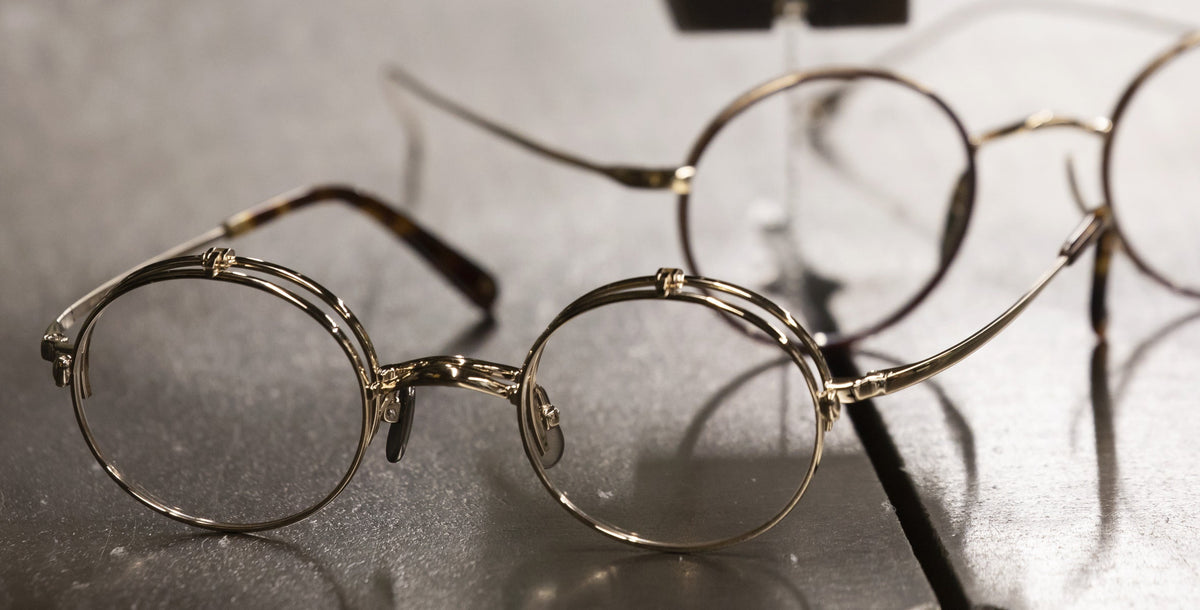
The circle is the first shape glasses ever had. Seven hundred years later it is still the one that changes a face the most with the fewest elements: two lenses, a bridge, nothing to hide behind.

The first shape of glasses.
Glasses were born in Italy at the end of the 1200s. In February 1306 the Dominican friar Giordano da Pisa said in a sermon that the art of making them had been discovered less than twenty years before. They were convex lenses, for people who could not see well up close.
The first image showing them is in Treviso: in 1352 Tommaso da Modena painted Cardinal Hugh of Saint-Cher reading, with two round lenses in front of his eyes. For centuries, before glasses became fashion, there were few possible shapes: round, oval, panto, rectangular, octagonal, square.
In the twentieth century the circle moved from the workshop to the screen. At the end of 1917 Harold Lloyd was looking for a signature for his new character, an ordinary young man: he chose a horn-rimmed frame without lenses. Later, perfectly round metal frames took the name of another face: “John Lennon glasses”.

Three ways to make a circle.
Two pairs of round glasses can look nothing alike. The material, the thickness of the rim and the line of the top all change.


03 / The models
Six round frames.
Four optical and two sun, from Japanese titanium to French acetate. Lenses from 41 to 49 mm.


How to choose them.
With a round frame, the position of the eye matters: your pupil should sit roughly in the centre of the lens. That is why the lens width is the first number to check. In this selection it ranges from 41 to 49 mm.
Then the bridge: on a round frame it is often high and narrow, and it keeps the glasses in place. Compare lens width, bridge and temple with a frame that already fits you well, as we explain in our guide to frame sizes. If your face is square, the circle softens it; if it is already round, a panto or a thin metal rim avoids the double effect.
Frequently asked questions
Before you choose
Which face shape suits round glasses?
A round frame softens strong features and square faces. On a face that is already round, a panto or a thin metal circle works better. Size matters more than face shape: the lens should be in proportion to your eyes.
What is the difference between round and panto?
A round frame is an almost perfect circle. A panto has a flatter, almost straight top and stays soft at the bottom.
Are round glasses suitable for progressive lenses?
It depends on the lens height. With a small lens there is less room for the reading zone: each product page lists the lens width and measurements, and we can check them with you before you order.
Titanium or acetate?
Titanium is light and thin; acetate gives the circle colour and depth. We compare them in titanium or acetate.
Can I try them before buying?
Yes, at our boutique in Crema, Italy. Online you will find photographs, measurements and availability for each model, with international shipping.
OCCHIO · Crema
A circle, seven hundred years later
Optical and sun, in titanium and acetate. Each model in a single piece.
Sources and images
Glasses, Wikipedia · Harold Lloyd, Wikipedia · Lesca Lunetier · TVR · Julius Tart Optical. Official brand photographs, used editorially for products sold by OCCHIO.