

Japanese eyewear: why it's different and which to choose
Pick them up and they seem to weigh nothing. From Sabae, Japan’s eyewear town: KameManNen titanium, EYEVAN style, TVR and Mr. Gentleman acetate, and six frames to try in Crema.
By OCCHIO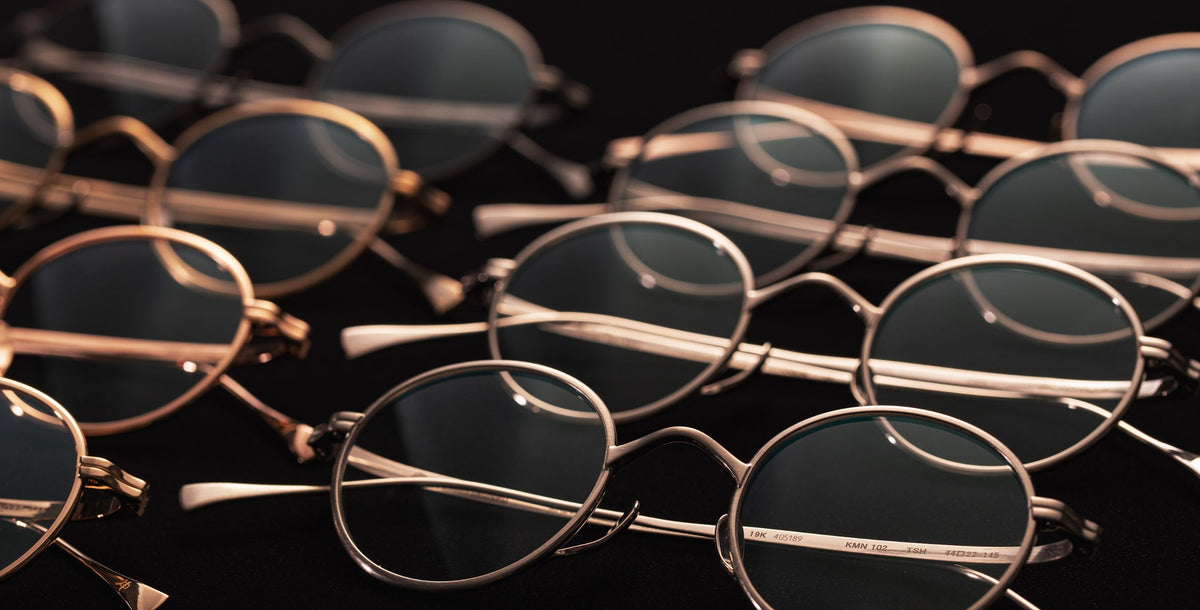
You feel it before you see it. Pick it up and it seems to weigh nothing. Open the temples and the movement is smooth, precise, without a trace of play. Then you put it on, and an hour later you forget you’re wearing it. That is what a good Japanese frame does.

A whole town that does one thing
In Sabae, eyewear is not an industry: it is the town’s trade. A frame passes through different workshops, each specialised in a single step. Whoever makes the mould does not polish, whoever polishes does not lacquer, whoever lacquers does not weld the bridge. Every pair of hands has done that one thing for a lifetime.
You see the result where an ordinary frame gives way: the hinge, the welds, the edge where the colour ends. On a well-made Japanese frame, there is nothing there to fix.
Yet what comes out of Sabae can be very different. Put a thin KameManNen rim next to a bold TVR acetate: the origin brings them together, the design takes them elsewhere.


Titanium, worked to the last tenth of a millimetre
Titanium is light, corrosion-resistant and well tolerated by skin that reacts to metals. It is also hard to work: it bends badly and can only be welded with dedicated equipment. Fukui has worked it for more than forty years, and KameManNen has made it its signature.
The name recalls a Japanese proverb about the tortoise’s long life: the idea is to make an object to keep for years. In the KMN 122, round and in titanium, the rim takes up almost no space. To see the work you have to come closer: bridge, nose pads, temple joints. Few elements, all in plain sight.

No logo. Just the right proportions
Eyevan was founded in Japan in 1972 with a simple idea: glasses to be worn, not shown off. Since 2013 the Eyevan 7285 line has been its most refined voice, made in Sabae. Thin metal, warm-toned acetates, a bridge that sits exactly where it should.
Then there are the hidden details. In EYEVAN’s Webb, the metal core of the temples carries an engraving inspired by classic car components, on both sides. From the front you don’t see it. Once you find it, you want to turn the frame over and look for the rest.

Two ways of working acetate
True Vintage Revival starts from archive shapes and the Sabae tradition. In the TVR 504 Kuro Crystal the eye stops on the bridge and the rim: a compact 46 mm lens, a 24 mm bridge, 150 mm temples. The character comes from how these parts relate.
With Mr. Gentleman the attention moves down to the nose: the Hemingway 2 pairs acetate with titanium nose pads, made by selected Sabae factories. It is a detail you feel when trying it on, more than one you see in photos.


How to recognise one in ten seconds
- The weight. A full titanium frame can weigh under twenty grams. If it feels almost empty in your hand, you’re on the right track.
- The hinge. Open and close the temples: the movement is even, with no jolts or side play. The screws sit flush.
- The finish. Look where the colour meets the metal: no smudges. The temple often reads “Made in Japan” or “Titanium”.
- The profile. Turn it sideways: a polished edge, the hinge, the point where the temple changes thickness. The front makes you choose; the profile tells the rest.
A note on fit: many Japanese frames have adjustable nose pads and bridges designed for lower nose bridges. On a European face a small adjustment is sometimes needed. In our boutique it takes a few minutes.

The OCCHIO selection
Six Japanese frames to try


Each model is available as a single piece. The T HENRI story is in the Journal, the story of the TVR craftsmen here.
Frequently asked questions
Before you choose
Where are high-end Japanese glasses made?
In Sabae, Fukui Prefecture. Almost all frames made in Japan come from here, thanks to a network of workshops each specialised in one stage of production.
Titanium or acetate?
Titanium is very light and thin; acetate gives more volume and colour. It depends on how visible you want the frame to be: we compare them in titanium or acetate.
Why is titanium so common?
Because it is light, corrosion-resistant and well tolerated even by skin that reacts to metals. It allows thin frames that stay stable on the face all day.
Do they suit a European face?
Yes. Many models have adjustable nose pads; where needed, we adjust bridge and temples in the boutique in a few minutes, so the frame sits as it should.
Can they take prescription lenses?
Yes, all optical frames in the selection take prescription lenses. If you have a particular prescription, write to us before buying and we’ll check together.
Can I try them in Crema?
Yes, at the OCCHIO boutique in Crema, Italy. Each model is a single piece: we suggest writing to us first to make sure it’s there.
OCCHIO · Crema
A Japanese frame is understood in the hand
Photos show the shape. The weight, the hinge, the way it rests on the nose: you only understand those by trying it. Choose online or come and hold it.
Sources and images
KameManNen: kamemannen.com. Eyevan 7285: eyevan7285.com. EYEVAN Webb and Sabae: eyevaneyewear.com. TVR. Mr. Gentleman. Official brand photographs, used editorially for products sold by OCCHIO.