

Progressive lenses: how they work and which to choose in the SEIKO range
How a progressive lens works, what sets SEIKO Brilliance, Prime, Allround, Room, Desk and Active apart, the SRC, Sensity and Polar-Thin treatments, the right frames and why measurements are taken in our boutique in Crema.
Somewhere around forty-five, the restaurant menu starts drifting away.
That is presbyopia: the crystalline lens, the eye's natural lens, loses elasticity and focusing up close becomes tiring. You can answer it with two pairs of glasses, one for reading and one for everything else. Or with a single pair and a progressive lens, which goes from far to near with no lines and no jumps. At OCCHIO! we choose it from the SEIKO range and measure it in the boutique, with the frame on your face.
One lens, three distances
A progressive lens has a different power from top to bottom. The upper part is for looking far away: the road, the other side of the room. The middle covers intermediate distance, the computer or the dashboard. At the bottom, reading. The transition between the three zones is continuous, along a narrow corridor that runs vertically through the lens.
On either side of the corridor, in the lower part, vision is less sharp. This happens in every progressive, of any brand: it is a consequence of the shape of the surface. What sets a good lens apart is how wide the sharp zones are, how gradual the transition is and how little objects seem to sway when you turn your head.
The SEIKO range
SEIKO is a Japanese brand of ophthalmic lenses; OCCHIO! is a SEIKO Vision Specialist. SEIKO progressives fall into two families: individualised ones, calculated for the person, and ones designed for a specific use during the day. Below, as SEIKO describes them.
SEIKO Brilliance
The most complete progressive in the range. The lens design is chosen from over three hundred variants, starting from three groups of data: your prescription and facial measurements, the way you use your eyes during the day and the lenses you have worn until now.
- Personal Design Selection System
- The system that chooses the lens design from more than 300 combinations, based on your data.
- Balance Zone Technology
- Maximum precision at the centre of the lens and thinner edges; reduces the magnifying or minifying effect of thick lenses.
- TwinEye Modulation 360°
- Calibrates the visual fields of both eyes together, so they work in balance even when you move.
- Digital Zoom Equalizer
- Makes the transition between distances more gradual, designed for people who often switch between a screen and their surroundings.
- Intelligent Magnification Control
- Reduces the swim effect: objects keep their shape at the edges of the visual field.
SEIKO Prime
Designed for people who demand precision and have two eyes with different corrections, even slightly.
- Optimised synchronisation
- Aligns the visual fields of both eyes even when sphere or cylinder differ by half a dioptre, in the side zones of the lens.
- Advanced Aspheric Design
- Reduces lateral distortion and disturbance in the reading zone, for sharp vision far and near.
Alongside the individualised lenses, SEIKO organises its lenses by moment of the day:
Allround
The everyday progressive: far, intermediate and near, for people who want one pair of glasses from morning to evening.
Room
An indoor progressive, optimised for the distances of a conversation or a meeting.
Desk
For people who spend many hours at the screen and the desk: wide near and intermediate zones, without the distance zone. It is a second pair for the desk, to use alongside the progressive.
Active
Prescription sun lenses, progressive too: over two hundred colours, polarised, mirrored and tinted photochromic versions.
Treatments
Super Resistant Clear (SRC). SEIKO's anti-reflective coating, with UV protection, in five versions. On a progressive it matters more than on a single-vision lens: the side zones already work at their limit, and reflections make them worse.
Sensity. The photochromic lens: clear indoors, it darkens by itself outdoors. With a Sensity progressive a single pair of glasses covers the sun too.
Polar-Thin. The polarised lens, in cool grey or warm brown: it removes reflections from water and tarmac and increases contrast. For driving, the sea, the mountains. We cover it in the guide to polarised lenses.
Colours. Over 220 tints, solid or gradient, on progressive sun lenses too.
Why measurements are taken in the boutique
The corridor that leads from far to near must fall exactly in front of the pupil. To know where, you need measurements that can only be taken with the chosen frame, adjusted and worn.
- Where the pupils areThe distance of each pupil from the centre of the nose, eye by eye: almost no face is symmetrical.
- At what height you look through the lensThe point where the pupil meets the lens when you look straight ahead. The reading zone starts from here.
- How the glasses sit on your faceHow tilted the front is, how curved, how far from the eyes. It changes from frame to frame and from nose to nose, and it is what SEIKO individualised lenses use for the calculation.
With this data the lens is calculated and processed for that frame. At collection we check on your face that everything is where it should be.
The frames
Almost any optical frame can take a progressive. It helps, though, if the lens has some height, so the reading zone has room, and if the glasses stay put on the nose: if they slip, the pupil leaves the right zone. Panto, square and mask shapes are the most comfortable. Four frames from the selection to start with:

Lesca Pica H827
Crown panto with keyhole bridge, in brown and amber tortoiseshell. Handmade in France.

AHLEM Prairie
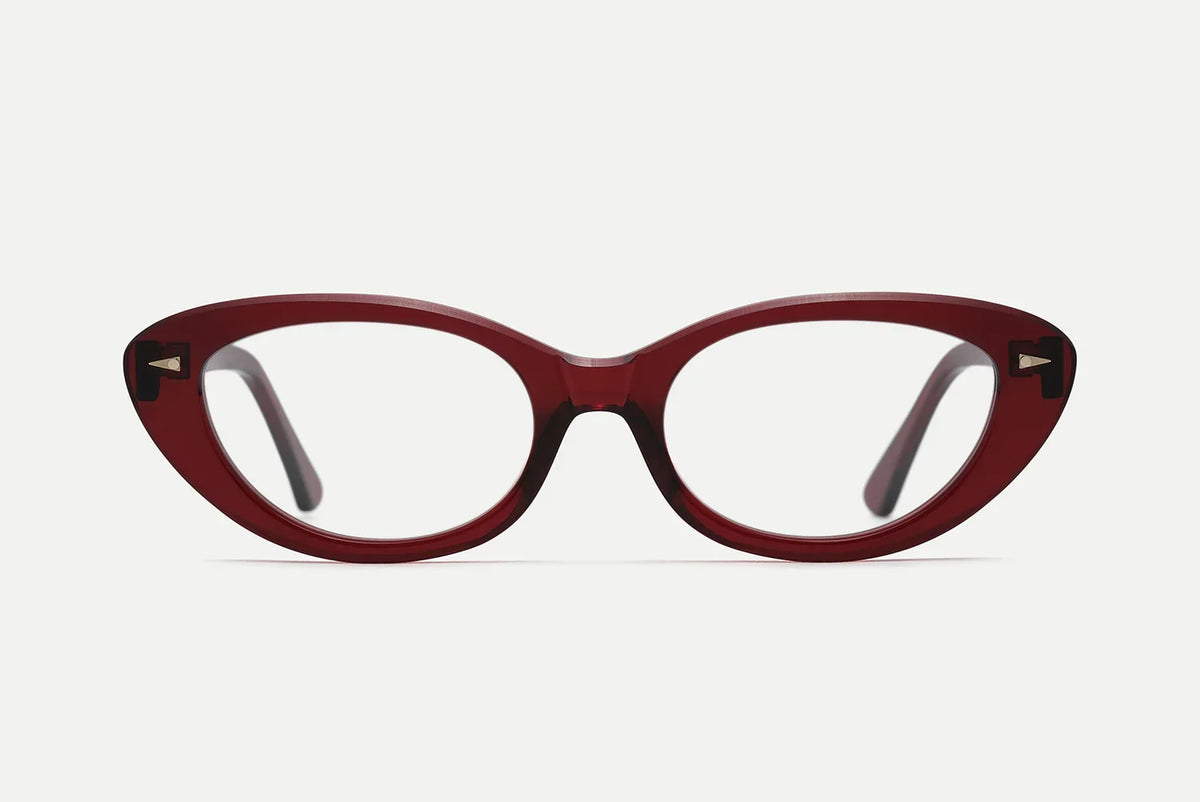
Burgundy acetate, size 54. Handmade in France.

Kuboraum K30
Square mask in Fire Havana, size 55. Handmade in Italy.

Cubitts Panton XXL
Rectangular lens with soft corners, in the largest size: for wide faces.
The first days
With your first progressive it usually takes from a few days to a couple of weeks. You learn to move your head a little more and your eyes a little less: to read you lower your gaze, on stairs you lower your chin. People switching from one progressive to another adapt faster. If something still feels off after two weeks, the cause is almost always the centring, and we recheck it in the boutique.
How it works at OCCHIO!
You can choose the frame online or in the boutique. We take the measurements for the progressive at via XX Settembre 15 in Crema, with the frame adjusted to your face; together we choose lens and treatments based on your prescription and on how you use your eyes during the day. Crema is forty minutes from Milan.
If progressives are not for you, read the guide to bifocal lenses; if you are worried about heavy lenses, the one on lens thickness explains how material and frame change the result.
What are the best progressive lenses?
The ones calculated on your data and on the frame you will wear. In the SEIKO range the most complete are the individualised ones, Brilliance and Prime; Allround, Room, Desk and Active answer specific uses during the day. A well-centred lens matters as much as the model you choose.
Can I order progressive lenses online?
The frame yes, the lenses no: they need measurements that can only be taken with the frame on, in the boutique in Crema.
What is the difference between a progressive and an office lens?
A progressive covers far, intermediate and near. An office lens, such as SEIKO Desk, gives up distance to widen intermediate and near: it is more comfortable for many hours at the screen, but not for driving.
Can I get progressive sunglasses?
Yes: tinted, polarised or photochromic, on many sunglass frames in the selection. Measurements are taken as for optical glasses.
How long does it take to get used to them?
From a few days to a couple of weeks with your first progressive, less if you have worn one before.
Measurements, in Crema
Choose the frame online or in the boutique. For the progressive, we are waiting for you at via XX Settembre 15.