

Prescription sunglasses: how they work, which lens to choose and 8 frames ready to glaze
Which sun frames take prescription lenses, which lens to choose (colour, category, polarized, photochromic), the difference between category and UV protection, how to order remotely from OCCHIO! in Italy and what sets the price. With eight sun frames in stock, ready for your prescription.
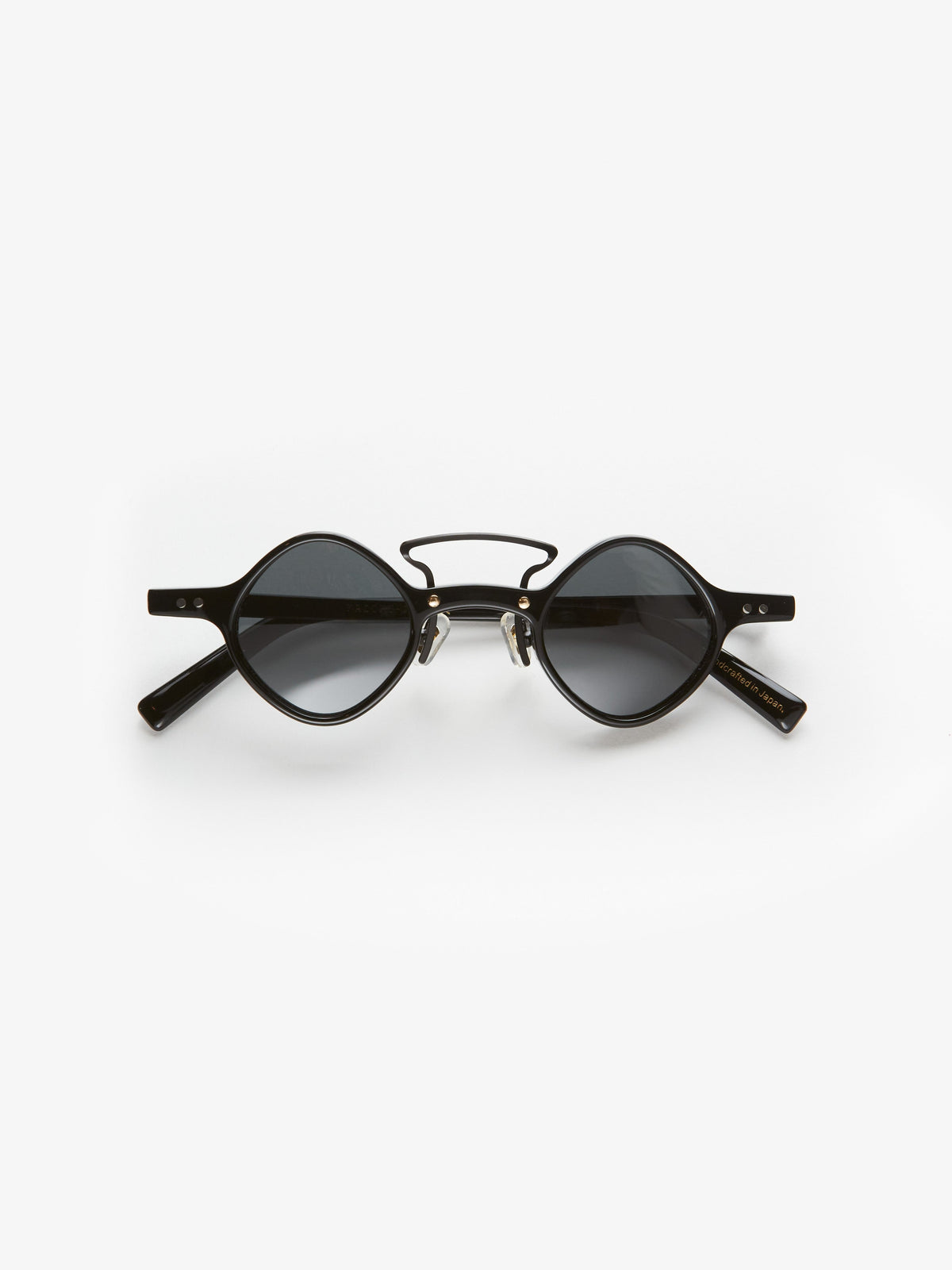
See clearly in the sun, in the frame you chose.
Prescription sunglasses are a sun frame with lenses made to your prescription: they correct your vision and filter light at once. Almost every frame in the OCCHIO! selection can be glazed, Kuboraum and T HENRI included. This guide explains which frames work, which lens to choose (colour, category, polarized, photochromic), how to read category and UV protection, how to order remotely from Italy and what sets the price. At the end, eight sun frames in stock, ready for your prescription.
What they are, and why they are not glasses with dark lenses
A prescription sun lens is made in the lab already tinted, or tinted after surfacing, on a lens that carries your correction: short-sightedness, long-sightedness, astigmatism and, with progressives, presbyopia too. The result is a true pair of sunglasses, with the density, colour and protection you would choose in any sunglasses, but through which you see sharply. That is the difference from two common workarounds: contact lenses under any sunglasses, and clip-ons over your glasses. The first works as long as you tolerate contacts; the second is heavy, scratches and changes the look of the frame.
Which sun frames can take prescription lenses
Most of them. OCCHIO product pages say “frame suitable for prescription lenses” when the maker states it, and that is the case for nearly all acetate and metal frames with flat or gently curved lenses. Three situations need an extra check:
- wrapped frames, with strongly curved lenses: the curve of the prescription lens must follow the frame, and with strong prescriptions the edge thickens and side vision suffers;
- rimless lenses (no rim, held by screws) and shield lenses: they can be done, but lens thickness and material must be chosen carefully;
- strong prescriptions, beyond 4–5 dioptres: a frame with a small lens and a regular shape is better, because a small lens stays thinner at the edge than a large one. The Kazoku Madman below, with a 38 mm lens, is an example.
In all three cases the answer takes two minutes: send us the model and your prescription before ordering and we tell you whether and how it can be done.
Which lens to choose
With prescription lenses you can choose between five kinds of sun lens, and combine some of them (a gradient polarized, a mirrored photochromic). The table helps you find your way.
| Lens | What it does | Who it suits |
|---|---|---|
| Solid tint | One even colour across the lens, category 2 or 3 | Anyone who wants true sunglasses: beach, summer, driving |
| Gradient | Darker at the top, lighter at the bottom | City and mid-season; anyone who reads or looks at a screen with sunglasses on |
| Polarized | Filters glare from water, snow, roads | Boats, fishing, mountains, long drives |
| Photochromic | Darkens outdoors, clears indoors | Anyone who wants one pair only; less suited to driving |
| Mirrored | Reflective outer finish on a tinted lens | Anyone who wants colour on the outside without showing the eyes; strong light |
The prescription sun lenses we fit have full UV protection, whatever colour and density you choose.
Lens colour
Three colours do the job of sunglasses without distorting what you see. Grey is neutral: colours stay as they are, it is the safest choice for driving and the most versatile. Green keeps colours true and adds contrast: the classic aviator colour, and it sits well on tortoiseshell. Brown warms the image and raises contrast: the most comfortable under changeable skies, in autumn and on the golf course. Light yellow, orange and pink are not sun lenses: they have other uses, explained in the guide to yellow lenses. To see the colours on frames: grey lenses, green lenses, brown lenses.
Lens category: how dark it is
Every sun lens has a filter category from 0 to 4 that shows how much visible light it lets through. With prescription lenses the category is your decision: the same prescription can be made in category 2 for the city or category 3 for the beach.
| Category | Light transmitted | When |
|---|---|---|
| 0 | 80–100% | Clear or near-clear lenses, indoors |
| 1 | 43–80% | Overcast sky, low light |
| 2 | 18–43% | City, medium light, spring and autumn |
| 3 | 8–18% | Full sun, beach, summer: the most common choice |
| 4 | 3–8% | High mountains, glaciers. Not suitable for driving |
Filter categories according to EN ISO 12312-1. With prescription lenses the category is chosen when ordering: usually 3 for true sunglasses, 2 for the city.
Category 3, the one most sunglasses come in, has a guide of its own: category 3 sunglasses, what it means and when to choose it.
UV protection: a different value
UV protection says how much ultraviolet radiation the lens blocks, and it has nothing to do with how dark it is: a light lens can have full UV protection and a dark lens may not. On ready-made sunglasses look for it on the label, as “UV 100%” or “UV400” (filters up to 400 nanometres). The prescription sun lenses we fit include full UV protection, whatever colour and density you choose: one of the advantages of having them made rather than buying any sunglasses.
Thickness: why lens size matters more than index
A prescription sun lens is usually larger than a prescription clear lens, because sun frames are larger, and edge thickness grows with lens size. Before talking about index (the thinnest materials reach 1.74, available on the SEIKO single-vision lenses we fit) it pays to choose the frame well: a contained lens width, a regular shape, correct centring. With 3 dioptres of myopia on a 44 mm lens the edge stays thin even in a standard index; on a 55 mm lens a high index is advisable. That is why we list the lens width on the models below where it helps.
Single-vision or progressive
Single-vision lenses correct one distance, usually far: the classic prescription sunglasses for driving, walking, the beach. Progressive sun lenses combine far and near in the same lens, like progressive glasses, for anyone over forty who wants to read their phone or the menu without taking their sunglasses off. Single-vision can be made remotely; progressives need measurements taken in person with the frame on and adjusted. At OCCHIO we fit SEIKO lenses, single-vision and progressive, photochromic and polarized too.
How to order prescription sunglasses online
- Choose the frame on the site or in the boutique. Check on the product page that it takes prescription lenses and compare the measurements with a pair you wear well (size guide).
- Write to us before paying, on WhatsApp or by email, with a recent prescription and your pupillary distance; if you do not know it we explain how to measure it. We check compatibility and send you a written quote for the lenses.
- Confirm and order: the frame on the site, the lenses with the quote. We fit them in the OCCHIO workshop in Crema and ship the finished pair worldwide, with the original lenses in the case if you want to keep them.
- Progressives: book an appointment in the boutique. We measure with the frame on your face and choose colour and category together in real daylight outside the door.
If you prefer, you can buy the frame alone and have it glazed by your own optician: shipping is free from €150 in Italy and the EU and from €200 to the United States.
How much they cost
The price of prescription sunglasses is the frame plus the lenses. The lenses depend on prescription, type (single-vision or progressive), material and index, colour and treatments: a solid grey single-vision lens in a standard index and a polarized photochromic progressive are two different objects. That is why we do not publish a price list: the quote comes before the order, includes everything, and if you change your mind about the frame we update it.
Eight sun frames ready for your prescription
All in stock, all stated by the maker as suitable for prescription lenses. Lens width is given where it helps you choose.

Peter and May Amy Black
The everyday black round, in thick acetate that holds a prescription lens well. Flat front and full rim: the easiest frame on this list to glaze.
View the frame
Kazoku Madman
A 38 mm lens: small, so with a strong minus prescription it stays thin at the edge. The sun frame we recommend to anyone with a high prescription who wants a light pair.
View the frame
Kuboraum Y3 Liberty Blue
A blue acetate that does not go unnoticed, on a shape that takes prescription lenses without fuss. The most direct way to own a Kuboraum in your own prescription.
View the frame
Kuboraum Z14 BMB
One of the few models where the maker states both values explained in this guide: category 3 and 100% UV. Thin metal, small lens: ideal for prescription lenses.
View the frame
Ahlem Varenne Grey Gold
Palladium-plated metal, handmade in France. The full rim holds a prescription lens securely, and the original grey lens can be reproduced exactly in a prescription version.
View the frame
Kuboraum J1 Black Matt
The cat-eye of the MASKE series, matte black with grey lenses. The tall shape leaves room for a progressive sun lens: the model we suggest to anyone who wants to read the menu on a terrace.
View the frame
KameManNen KMN 9502 GD Gold
One of Japan's oldest eyewear houses, in gold titanium: a light frame that stays comfortable on the nose even with thicker prescription lenses.
View the frame
T HENRI Evija L'or Bleu
A titanium micro-production, 199 numbered pieces, stated by the maker as suitable for prescription lenses. For anyone who wants prescription sunglasses that exist nowhere else.
View the frameKeep reading
To choose the shape: the best sunglasses 2026 and which frame for your face shape. For the lens: category 3 and polarized lenses.
What are prescription sunglasses?
Sunglasses with lenses made to your prescription: they correct your vision (short-sightedness, long-sightedness, astigmatism, presbyopia) and filter light like a sun lens at the same time. The frame is the one you choose; the original lens is replaced by a tinted, polarized or photochromic prescription lens.
Can I put prescription lenses in any sunglasses?
Almost. Most acetate and metal frames with flat or gently curved lenses are fine. Strongly wrapped frames, rimless lenses held by screws and shield lenses need more care. OCCHIO product pages state when a frame is suitable for prescription lenses; if in doubt, write to us before ordering.
Can sunglasses have progressive lenses?
Yes. Progressive sun lenses combine distance and near vision: useful in the car, on a boat, on a terrace with a book. They need measurements taken in person with the frame on your face, so they are made in the boutique in Crema, not remotely.
Can I order prescription sunglasses online?
With single-vision lenses, yes: choose the frame on the site, write to us before buying with a recent prescription and your pupillary distance, we check compatibility and send you a quote; we fit the lenses in the OCCHIO workshop in Crema and ship the finished pair worldwide. Progressives need an appointment in the boutique.
How much do prescription sunglasses cost?
The price is the frame plus the lenses, and the lenses depend on prescription, type (single-vision or progressive), material and index, colour and treatments (polarization, photochromic, anti-reflective). We do not publish a price list because it changes with every prescription: the quote comes before the order, in writing, and includes everything.
What is the difference between lens category and UV protection?
The category (0 to 4) says how dark the lens is, i.e. how much visible light it lets through. UV protection says how much ultraviolet radiation it blocks: look for “UV 100%” or “UV400”. The prescription sun lenses we fit have full UV protection whatever colour you choose; the category is yours to decide with us.
Photochromic lenses or prescription sunglasses?
Photochromic lenses darken outdoors and clear indoors: one pair for everything. Prescription sunglasses are always dark and usually darker than a photochromic lens, especially in the car, where the windscreen slows photochromic activation. People who spend a lot of time outdoors or driving usually prefer a second pair.
Can prescription sun lenses be polarized?
Yes, in grey, brown or green, single-vision or progressive. Polarization removes glare from water, snow and roads; worth weighing up if you often use screens with your sunglasses on, because some displays look darker.
Message us to have your sunglasses made to your prescription, or visit the boutique
Send us the model you like and your prescription: we tell you whether it can be glazed, with which lens and at what price, before you order. Or come to Via XX Settembre 15 in Crema and compare colours and categories in real daylight.